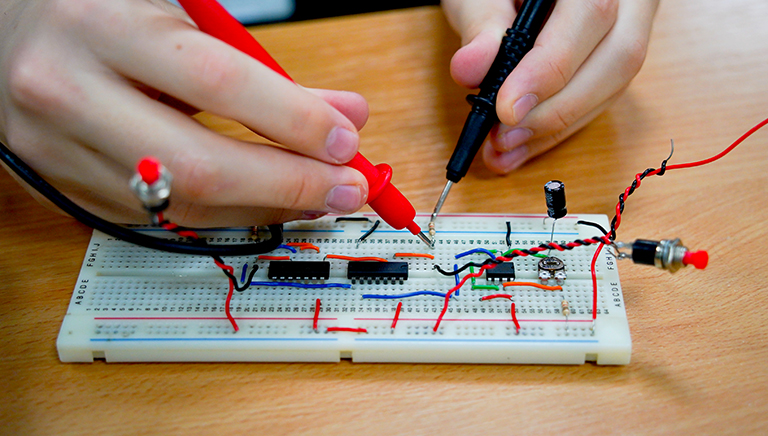
Introduction
The course aims to:
- develop scientific knowledge and understanding of the behaviour of electronic circuits
- develop an understanding of electronics as an engineering discipline
- develop a variety of practical, mathematical and problem-solving skills
- learn how to apply observational, practical and problem-solving skills
- develop creative and evaluative skills in the development of electronic systems
Where does it lead?
A Level Electronics is seen by universities as a ‘science subject’. It complements physics, computer science and maths A Levels for students who are considering engineering, applied physics or computing degrees or careers. There is a great opportunity for specialisation in many different specific fields such as avionics, bioelectronics and robotics.
Course details
Year 12
- Core concepts: System synthesis, DC electrical circuits, input & output sub-systems, energy & power.
- Principles of electronics: Semiconductor components, logic systems, op-Amps, signal conversion, AC circuits & passive filters, communications systems, wireless transmission, instrumentation systems.
- Assessed through 2hr 45min written examination worth 40% of qualification.
Year 13
- Application of electronics: Timing circuits, sequential logic systems, microcontrollers, digital communications, optical communication, mains power supply systems, high power switching systems, audio systems.
- Assessed through 2hr 45min written examination worth 40% of qualification.
- Extended system design and realisation tasks: 2 tasks worth 20% of qualification - design a microcontroller system and program using assembly language, and design and create an electronic system.
Examination Board
Eduqas
Entry Requirements
English GCSE 4+ Required?
Yes
Maths GCSE 4+ Required?
Yes
Additional Entry Requirements
66+ GCSE Science, 6+ in GCSE Maths